
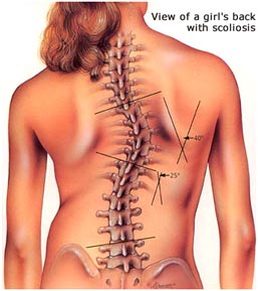
 Scoliosis - Cobb Angle Scoliosis - Cobb Angle Free Scoliosis Screening at Dunsborough Physiotherapy Centre. Phone Now: (08) 97553600 Dunsborough Physio Centre is offering free scoliosis screening for all year 4, 5 and 6 students in Dunsborough. What is Scoliosis? Scoliosis is an abnormal sideways curvature of the spine measuring greater than 10 degrees, accompanied by vertebral rotation. The most common form of scoliosis is idiopathic. The cause is multi-factorial, and not completely understood. Depending on the degree of curvature treatment is hugely varied. Common symptoms: back and neck pain and stiffness, obvious altered posture. Risk factors: gender (female), age (prevelant in teenagers), family history. Scoliosis occurs most often during the growth spurt just before puberty (most common in girls aged 9-14). While scoliosis can be caused by conditions such as cerebral palsy, the cause of most scoliosis is unknown. Scoliosis is approximately 8 times more common in girls. If you are female and your mother has suffered from scoliosis you are 20 times more likely to suffer from scoliosis. About 1 in 10 to 1 in 20 girls develop a certain degree of scoliosis in early adolescence. Adolescent idiopathic scoliosis is present in 2 to 4 percent of children between 10 and 16 years of age. About 2% of girls have a curve which warrants medical observation. 3 girls per 1000 will require treatment during the growth phase. If treatment is required the earlier it is undertaken the better the long-term result. 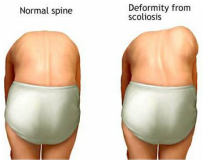 Scoliosis - Adam's Forward Bend Test Scoliosis - Adam's Forward Bend Test How to test for Scoliosis Adam’s Forward Bend Test: with the person leaning forward with straight knees, hands hanging down to the floor, look for a raised rib-cage on one side. A “rib hump” is a hallmark of scoliotic curves greater than 10 degrees. 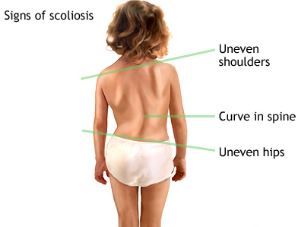 Scoliosis Scoliosis How to test for Scoliosis Observation: standing up straight, with feet together and arms by side, look from behind for the spine being obviously curved, one shoulder / shoulder blade sitting higher than the other, one shoulder blade more prominent than the other (sticking out more), the head not centered over the body, uneven gaps between the arms and the trunk, or uneven hips (one hip sticking out more than the other). 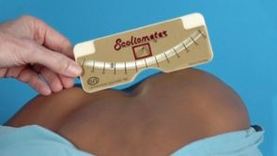 Scoliometry Scoliometry How to Test for Scoliosis - Scoliometer During the Adam's Forward Bend Test, using a scoliometer, the degree of torso distortion is measured by placing the scoliometer on the thoracic spine / rib cage and then the lumbar spine at the highest point of the curve (apex). At least half of those measured with obvious distortion will have a degree of scoliosis. An angle of 5-7 degrees or greater may warrant further investigation. This angle measurement is different to a Cobb angle measurement (attained via an X-ray). 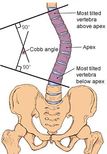 Cobb Angle Cobb Angle How to test for Scoliosis - X-Rays X-Ray: if a child appears to have a scoliosis an x-ray may be ordered to assess the angle of the curve (Cobb angle). This Cobb angle may need to be re-assesed every 4 - 6 months if the child is still growing. Medical Assessment
Evaluation of growth potential is assessed using the Tanner scale (sexual maturity rating) and the Risser grading system (measuring the stage of skeletal growth). Tanner stages 2 to 3 occur just after the onset of the pubertal growth spurt and correlate to the time of maximum progression of scoliosis. Risser grade is directly correlated with the risk of curve progression. Treatment There is no cure for idiopathic scoliosis. Only 10 percent of children presenting with scoliosis have curves that progress and require medical intervention. Children who have mild scoliosis are monitored closely, usually with X-rays, to see if the curve (Cobb angle) is getting worse. In many cases, no treatment is necessary. 0.2% of children (with a 25 degree curve) may need to wear a brace to stop the curve from worsening. Others with a 40-45 degree progressing curvature may need surgery (0.1%) to keep the scoliosis from worsening and to straighten severe cases of scoliosis. Early intervention is essential to lessen the need for more dramatic intervention (i.e. surgery). If untreated severe scoliosis can cause long-term back pain and breathing difficulty. Contact us at Dunsborough Physiotherapy Centre if you require further advice, or want us to assess your child for scoliosis. We are able to refer for x-rays as appropriate to assess the degree of scoliosis. Comments are closed.
|
AuthorBen Liston of Dunsborough Physiotherapy Centre has over 25 years of physiotherapy experience. Archives
September 2016
CategoriesAll Hydrotherapy Massage Therapy Real Time Ultrasound RICER Injury Management Snow Skiing And Snowboarding Injury Prevention SPRIG Program (Injury Prevention Program For Children And Adolescents) Surfing Injury Info Winter Sports Injury Info |
- Home
- About Us
-
Dunsborough Physio Services
- Physio Services Provided
- Sports Rehab >
-
Physio Exercises
>
- Physio Exercises (All)
- Lumbar / Thoracic Flexibility Exercises
- Cervical Flexibility Exercises
- Upper Limb Flexibility Exercises
- Lower Limb Flexibility Exercises
- Upper Limb Strengthening Exercises
- Lower Limb Strengthening Exercises
- Pilates Core Strengthening Exercises
- Foam Roller Exercises
- Balance (Proprioception) Exercises
- Products for Sale
- Common Injuries Treated
- Surgical Info >
- Pilates
- Bike Fit
- Workstation Set Up
- Blog
- Contact
- Home
- About Us
-
Dunsborough Physio Services
- Physio Services Provided
- Sports Rehab >
-
Physio Exercises
>
- Physio Exercises (All)
- Lumbar / Thoracic Flexibility Exercises
- Cervical Flexibility Exercises
- Upper Limb Flexibility Exercises
- Lower Limb Flexibility Exercises
- Upper Limb Strengthening Exercises
- Lower Limb Strengthening Exercises
- Pilates Core Strengthening Exercises
- Foam Roller Exercises
- Balance (Proprioception) Exercises
- Products for Sale
- Common Injuries Treated
- Surgical Info >
- Pilates
- Bike Fit
- Workstation Set Up
- Blog
- Contact
Search by typing & pressing enter
 RSS Feed